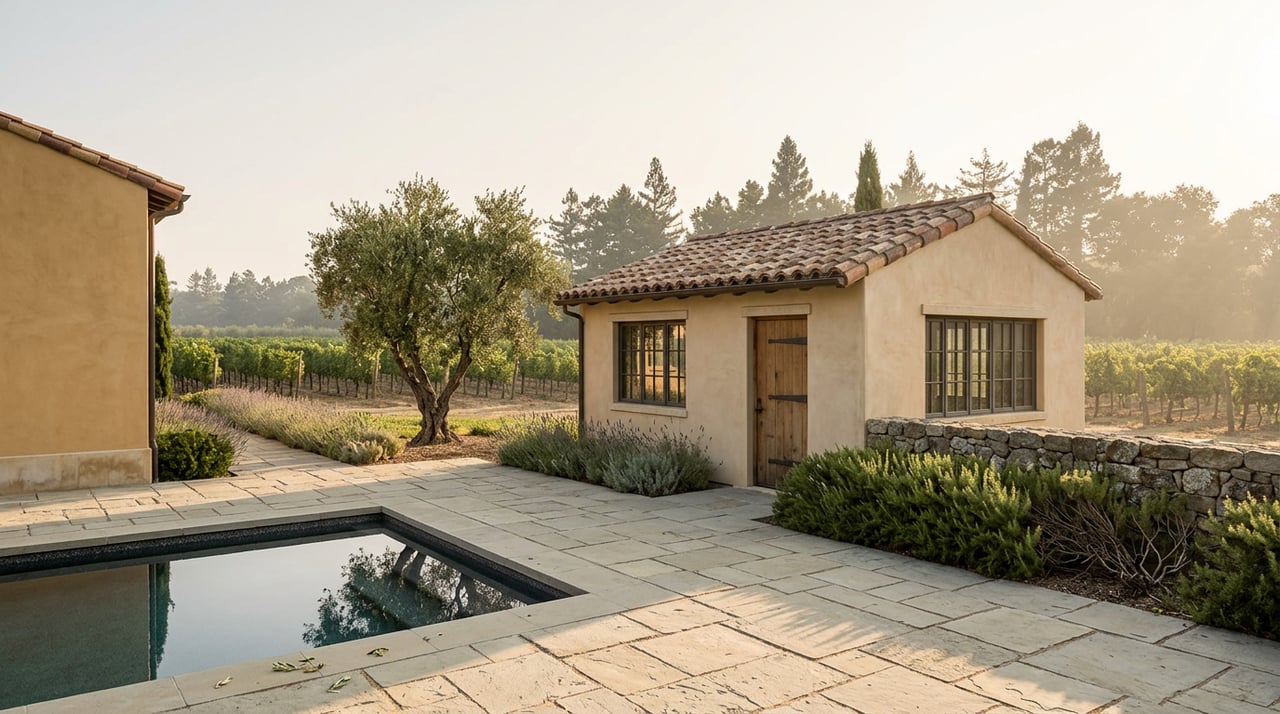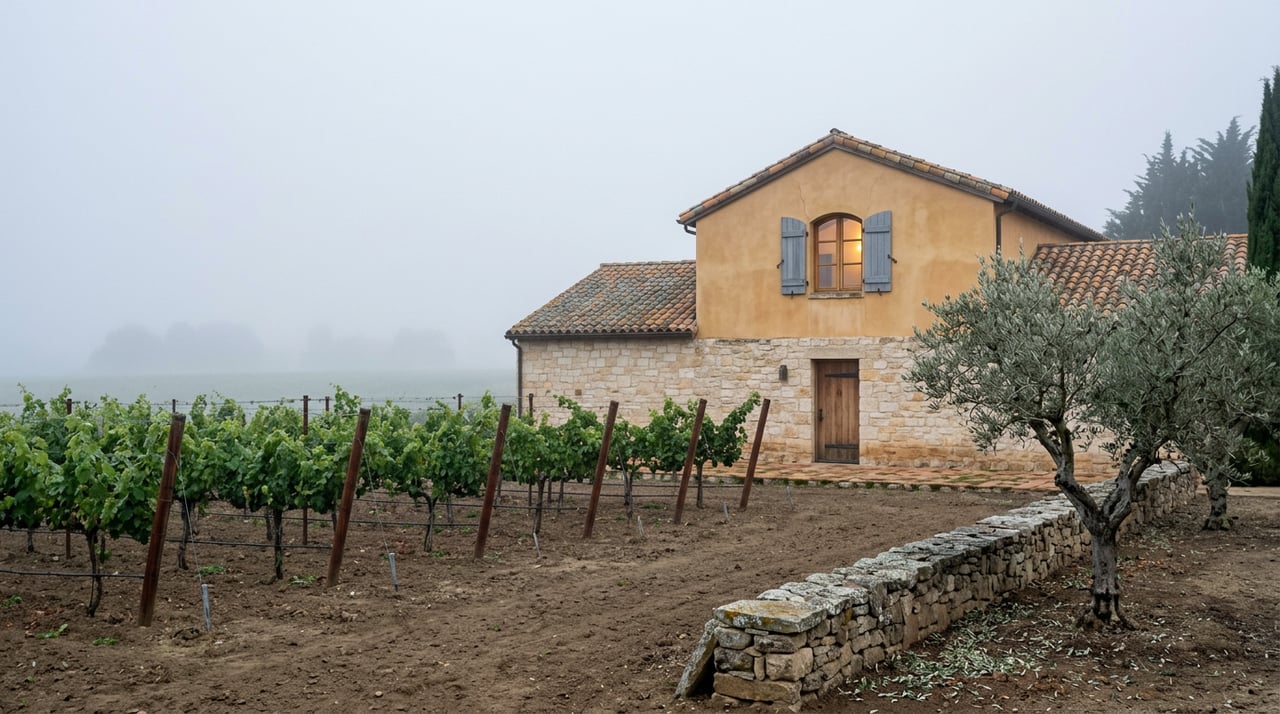
A Rutherford vineyard estate does not sell the way a house sells. Somewhere in the title report, often past the survey and the water rights and the easements, sits a document that has nothing to do with the architecture or the Cabernet in the ground: an Agricultural Preserve contract under California's Williamson Act. Most listing conversations treat it as boilerplate. It is not. It is a legal obligation that transfers to whoever buys the property, and in 2026 it is getting more scrutiny from Napa County than it has in years.
For a seller, that scrutiny changes the timeline. For a buyer, it changes what "value" actually means on a parcel that looks like farmland from the road and functions like a $10 million private estate behind the gate.
Why The Contract Doesn't End At Closing
Napa County has been signing Williamson Act contracts since 1969, when it established the Napa Valley and Wooden Valley Agricultural Preserves. The deal is simple on paper: a landowner agrees to keep the parcel in agricultural use, and in exchange the county taxes it on farm income rather than market value. What makes it relevant to a sale is a single fact that catches people off guard almost every time: the contract runs with the land. It is binding on all successors in interest, which means a buyer inherits both the reduced tax bill and the restriction that produced it, whether or not anyone walks them through it before closing.
That is not a minor disclosure item. It is the difference between a buyer who understands they've purchased a working agricultural parcel with legal limits on what it can become, and a buyer who assumes the vineyard rows are just landscaping they can remove.
What It Costs To Get Out Early
If a seller wants the property free of that contract before listing, there are two paths, and neither is fast.
The first is non-renewal. Because Williamson Act contracts run on a rolling ten-year term with automatic annual renewal, filing a non-renewal notice starts a nine-year countdown during which the tax assessment climbs gradually until the contract finally terminates. It is a slow release valve, not something you file in February and clear by fall.
The second is cancellation, and it is expensive by design. A landowner can ask the Board of Supervisors to cancel the contract outright, but the board can only approve it after making specific findings under California Government Code Section 51282, at a public hearing. If approved, the landowner pays a cancellation fee equal to 12.5 percent of the property's unrestricted fair market value. On a $6 million Rutherford parcel, that is $750,000 paid to exit a program that was supposed to save money on taxes. Sellers who assume they can simply "drop" the contract before going to market are usually the ones who find this out from their attorney, not from their first conversation with an agent.
The Audit Rutherford Sellers Didn't Used To Face
For decades, the practical risk of an ag-preserve parcel was mostly about restriction, not enforcement. That has shifted.
Napa County's civil grand jury has returned to the Williamson Act program more than once in recent years, and its report subtitled "Subsidizing a Lifestyle" argued the tax breaks are concentrated among wealthy landowners and corporations buying up Napa County agricultural land, with one Assessor's Office employee going on record calling the program "welfare for the rich." The county pushed back hard. In an August 2024 response, the Board of Supervisors defended the program as a tool for preserving open space that outweighs short-term tax revenue, and it declined the grand jury's call for an independent cost-benefit study.
But the county did not dismiss everything. On May 8, 2024, the Board directed staff to tighten compliance, and the follow-through has already produced a number worth knowing if you're preparing a Rutherford estate for market: county officials identified 64 Williamson Act contracts, out of 692 countywide, where no agricultural use appeared to be occurring on the parcel. That's roughly 9 percent of all contracts on the books. The county's plan is to file notices of non-renewal against any of those owners who can't produce evidence of active farming.
A separate grand jury report released in July 2025 examined the county's winery use permit process and found similar friction. The county rejected or partially rejected all five findings, but supervisors sent several of the responses back for revision, including how the county's own winery permit database should be treated as a source of truth. Whatever the final outcome, the pattern is the same across both reports: entitlements that used to be treated as settled paperwork are now being checked, questioned, and in some cases reopened.
For a Rutherford seller, this means the ag-preserve status attached to your parcel is not a formality your title company will wave through. If a title search shows a Williamson Act contract on record, expect a buyer's attorney in 2026 to ask for proof of active agricultural use, not just a copy of the contract. Sellers who have let farming activity lapse, or who inherited a contract without a clear paper trail of production, should resolve that question before it becomes a renegotiation point at the appraisal stage.
The Acreage Math Nobody Mentions At The Open House
Rutherford's real estate identity was built on tiny parcels carrying outsized prestige. That creates a wrinkle with the Williamson Act's own size rules. To qualify for a standard agricultural preserve contract, a parcel generally needs to be at least 10 acres if it's classified as prime agricultural land, or 40 acres if it isn't. Each contract also covers only one legal parcel.
That threshold matters in a place where a legendary five-acre compound can trade for more than a modest 40-acre hillside lot elsewhere in the valley. Some of Rutherford's most storied properties simply don't qualify for a contract at all because they were subdivided below the minimum long before the current owner took title. Others sit right at the line, where a lot line adjustment during a sale can inadvertently affect eligibility. Neither scenario shows up in a typical comparative market analysis. Both show up in escrow.
What Institutional Buyers Already Know
Sophisticated buyers have been pricing this friction into their offers for years, even when the rest of the market hasn't caught up.
Consider Sloan Estate, a 40-acre property on Auberge Road above the Auberge du Soleil resort, sold to Goldin Financial Holdings, a Hong Kong-based investment firm, for $40 million, a figure that dwarfed the $12.5 million assessed value the county had on record for the land and improvements in 2010. The parcel size wasn't an accident. At 40 acres, Sloan cleared the non-prime threshold with room to spare, and the deal included the winery, the vineyards, an 8,824-square-foot French chateau-style home, caves, gardens, and a pool, sold separately from the winery's name and existing inventory. It remains one of the clearest illustrations of how acreage, not just address, drives what a Rutherford estate can legally be and what it can be worth.
The appetite for this kind of land hasn't slowed. In April 2026, St. Supéry, owned by Chanel, announced it had acquired Rudd Estate and the Crossroads brand, adding Oakville's storied Rudd vineyards to a portfolio that already included St. Supéry's own Dollarhide Estate Vineyard and two Rutherford Estate Vineyard parcels. With the acquisition, St. Supéry now holds more than 1,650 acres across four distinct parcels, 600 of them planted to vines. Deals at that scale don't happen without exhaustive title and entitlement review, including a hard look at every ag-preserve contract on record. Individual sellers preparing a single Rutherford estate for market are facing a smaller version of the same diligence, from buyers who now expect it.
A Few Questions Worth Asking Before You List
Does every Rutherford property carry a Williamson Act contract? No. Many of the valley's smaller historic compounds fall below the 10-acre prime or 40-acre non-prime thresholds and were never enrolled. Check the parcel's status with the Napa County Assessor before assuming either way.
If I inherit a contract as a buyer, do I automatically get the tax benefit? The contract and its restrictions transfer, but the reduced assessment is recalculated at the point of sale using the same formula the Assessor applies to any enrolled parcel, comparing agricultural income value, Proposition 13 base value, and current market value, with the lowest of the three enrolled. It is not a guaranteed windfall, and it is worth confirming the actual number before you count on it.
Can I just let the contract lapse instead of paying to cancel it? Yes, through non-renewal, but plan for a nine-year phase-out, not a quick exit. If your timeline for selling is shorter than that, cancellation is the only fast option, and it comes with the 12.5 percent fee and a public hearing.
A Rutherford vineyard estate is never just the house and the view. It's the contract sitting quietly in the title file, the acreage math that decided whether that contract exists at all, and, increasingly in 2026, the county's willingness to ask whether the farming behind the tax break is actually still happening. Getting those answers before you list is the difference between a clean escrow and a renegotiation you didn't see coming.
If you're weighing a sale or a purchase in Rutherford and want a clear read on what's actually attached to a specific parcel, Yvonne Rich has spent decades untangling exactly this kind of Napa Valley paperwork. Contact Yvonne to talk through what your property carries before it goes to market.